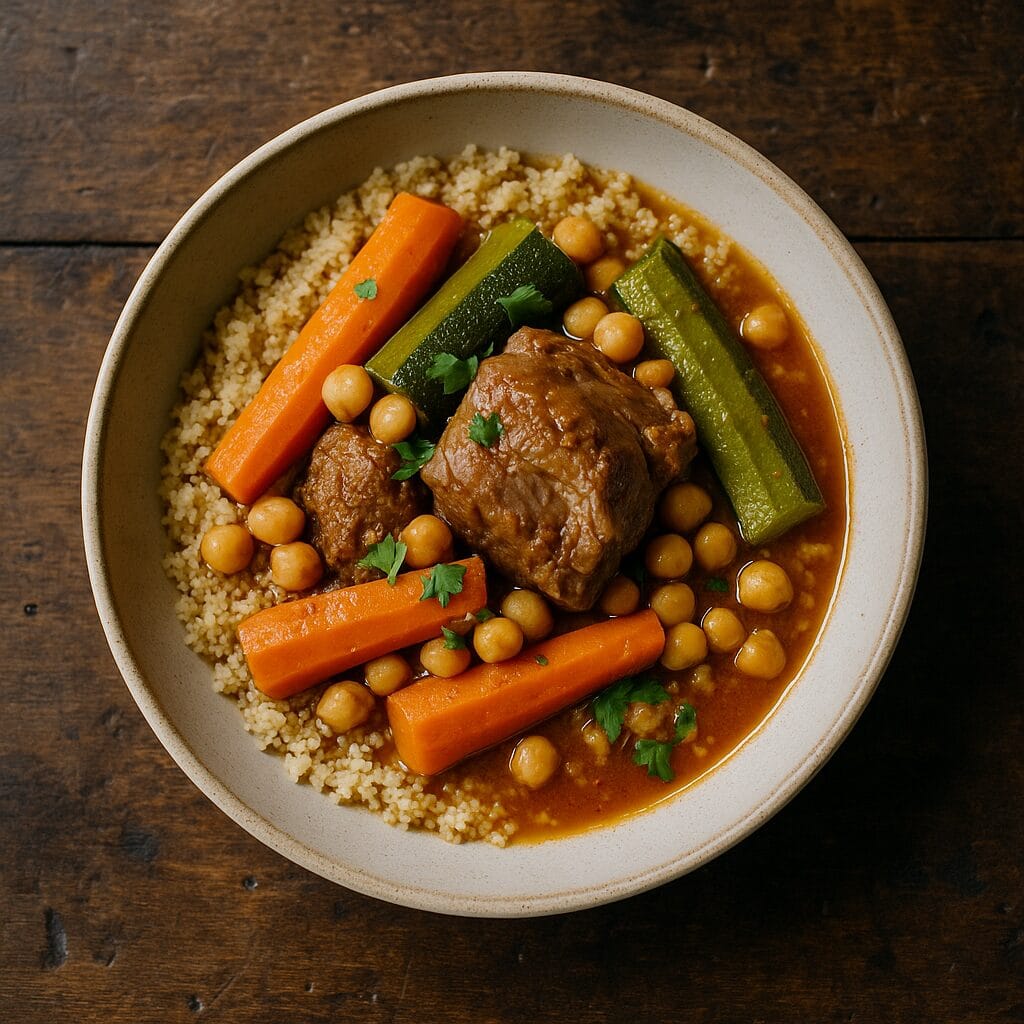
Moroccan Couscous with Lamb, Chicken and Vegetables
With store-bought pre-steamed couscous, this classic can go from stovetop to table in under an hour, no couscoussier required. Make the spiced broth ahead, then reheat and ladle it over freshly fluffed grains for a fast, flavor-packed meal any night of the week.
Prep Time
40 minutes
40 minutes
Cook Time
120 minutes
120 minutes
Total Time
160 minutes
160 minutes
Ingredients
Couscous (medium-grain semolina) 3 cups / 600 g
- Lamb shoulder or shanks, bone-in, cut into chunks 1 ½ lb / 700 g
- Chicken pieces (thighs and drumsticks) 1 ½ lb / 700 g
- Onions, finely chopped 2 large
- Ripe tomatoes, grated or diced 2 medium
- Carrots, peeled and cut into thick sticks 3 medium
- Zucchini (courgettes), split lengthwise 3 medium
- Turnips, peeled and quartered 2 medium
- Potatoes, peeled and halved 2 medium
- Pumpkin or butternut squash, large cubes 12 oz / 350 g
- Green cabbage, wedged 8 oz / 230 g
- Canned chickpeas, drained 1 cup / 200 g
- Raisins, pre-soaked (optional) ½ cup / 70 g
- Fresh cilantro, tied in a bundle ½ bunch
- Fresh flat-leaf parsley, tied in a bundle ½ bunch
- Extra-virgin olive oil 3 tbsp
- Unsalted butter or smen (preserved Moroccan butter) 2 tbsp
- Ground turmeric 1 tsp
- Ground ginger 1 tsp
- Sweet paprika 1 tsp
- Ground cumin ½ tsp
- Ground cinnamon ¼ tsp
- Ras el hanout (optional but traditional) 1 tsp
- Saffron threads, crumbled and soaked 1 pinch
- Freshly ground black pepper ½ tsp
- Fine sea salt 2 tsp or to taste
- Water or light chicken stock 8 cups / 2 L
- Harissa paste, to serve (optional) 2–3 tbsp
Method
Trim excess fat from lamb chunks
- Season lamb with salt black pepper ground ginger turmeric and saffron
- Heat olive oil in a large couscoussier or heavy pot over medium high heat
- Brown seasoned lamb on all sides
- Add chicken pieces to the pot
- Sear chicken until the skin is lightly golden
- Stir chopped onions into the pot
- Cook onions until they become translucent
- Add grated or crushed tomatoes to the pot
- Stir tomato paste into the tomatoes
- Sprinkle ground cumin ground coriander and cayenne over the mixture
- Add a tied bundle of whole cilantro and parsley
- Pour in enough water to cover the meat by about two inches
- Bring the contents to a boil
- Skim off any foam that rises to the surface
- Reduce the heat to medium low
- Cover the pot
- Simmer the meat for about forty five minutes
- Rinse canned chickpeas under cold water
- Add chickpeas to the pot
- Peel carrots
- Cut carrots into large chunks
- Peel turnips
- Cut turnips into wedges
- Peel pumpkin or sweet potato
- Cut pumpkin or sweet potato into large pieces
- Trim zucchini
- Cut zucchini into thick sticks
- Trim green beans
- Add carrot chunks to the pot
- Add turnip wedges to the pot
- Simmer the stew for fifteen minutes
- Add pumpkin or sweet potato pieces to the pot
- Simmer for ten minutes more
- Add zucchini sticks to the pot
- Add green beans to the pot
- Taste the broth
- Adjust seasoning with salt and pepper
- Stir in a pinch of ras el hanout if desired
- Place dry couscous grains in a large shallow bowl
- Drizzle one tablespoon of olive oil over the couscous
- Rub the oil into the grains with your fingertips
- Mix one teaspoon of salt into the couscous
- Pour just enough cold water over the couscous to barely cover it
- Let the couscous absorb water for ten minutes
- Break up any clumps of couscous with your fingers
- Transfer damp couscous to the steamer basket of the couscoussier
- Set the steamer basket over the simmering broth
- Steam the couscous for about fifteen minutes
- Tip the steamed couscous back into the shallow bowl
- Sprinkle half a cup of cold water over the couscous
- Fluff the grains with a fork
- Let the couscous stand for five minutes
- Break up clumps again with fingertips
- Return the couscous to the steamer basket for a second steaming
- Steam the couscous for another fifteen minutes
- Transfer the couscous back to the bowl
- Work two tablespoons of butter or smen into the couscous
- Splash a little more water onto the couscous if the grains feel dry
- Fluff the grains thoroughly
- Separate the grains thoroughly with your fingers
- Return the couscous to the steamer for a final ten minute steaming
- Taste the couscous
- Adjust salt if needed
- Check the vegetables for tenderness
- Check the meat for tenderness
- Remove the herb bundle from the broth
- Add whole hot chilies to the broth if you want extra heat
- Ladle a few cups of broth over the couscous
- Toss the couscous gently to moisten it
- Transfer the couscous to a large serving platter
- Form the couscous into a mound
- Create a well in the center of the couscous mound
- Arrange lamb pieces in the well
- Arrange chicken pieces in the well
- Surround the meat with carrots turnips pumpkin zucchini and other vegetables
- Scatter chickpeas over the couscous
- Moisten the dish with additional broth to taste
- Serve remaining broth in bowls on the side
- Offer harissa for guests to stir into their broth
Nutrition (whole recipe)
Calories
6574 kcal Protein
298 g Fat
261 g Carbs
774 g Fiber
91 g Sugar
121 g
6574 kcal Protein
298 g Fat
261 g Carbs
774 g Fiber
91 g Sugar
121 g
Notes
For light, fluffy grains every time, drizzle the dry couscous with a tablespoon of olive oil and rub it in with your fingertips before adding hot liquid—each grain coats and stays separate. If you like a hint of sweetness, scatter a handful of golden raisins over the couscous while it steams; they plump up and echo the warm spices in the broth.